On this page
- What are the five common retail commission plans?
- Flat rate on every sale
- How do commission tiers work, on the whole day or only the part above?
- What is a sales goal bonus?
- How does hourly pay plus commission work?
- Who gets credit on a split sale?
- How does commission affect overtime?
- Should staff see their own commission numbers?
- Can I change the commission plan mid-period?
- How does commission work in MazalPOS?
- What does commission tracking cost?
- What should a commission plan checklist cover?
Key takeaways
- Most retail stores pay an hourly rate plus commission, with tiers or a goal bonus for big days.
- Tell staff whether a tier pays the whole day or only the part above the line.
- Split sales should always add up to 100%.
- Federal rules count commissions in the regular rate of pay, so they raise overtime pay.
- Staff who can see their own sales and commission sell more on purpose.
A good retail commission plan pays a percentage of what each employee sells, is simple enough that staff can check it themselves, and is worked out by the register on every sale, not by hand at the end of the pay period. Most stores use one of five plans: a flat rate, tiers, a sales goal bonus, hourly pay plus commission, or a mix. Here is how each one works, with worked examples, and the federal rule every plan has to respect.
What are the five common retail commission plans?
- Flat rate: the same percentage on every sale.
- Tiers: a higher percentage once sales pass a line.
- Sales goal bonus: a fixed dollar bonus when a goal is reached.
- Hourly plus commission: a steady hourly rate with commission on top.
- Split credit: two employees share one sale.
The right one depends on what you want more of. A flat rate rewards every sale the same. Tiers and goals reward the big days. Hourly plus commission keeps pay steady on a slow Tuesday, which matters for keeping good people.
Flat rate on every sale
A flat rate is the easiest plan to explain: for example, 5% of everything an employee sells. Sell $800 in a day and the commission is $40. It is fair and simple, but it does not push anyone to sell more on a busy day, because the fifth sale pays the same as the first.
How do commission tiers work, on the whole day or only the part above?
Commission tiers raise the percentage once sales pass a line. Say 5% up to $1,000 in a day and 8% above $1,000. There are two ways to pay it, and staff need to know which one you use.
- Only the part above: on a $1,200 day, 5% of $1,000 is $50 and 8% of the last $200 is $16, so $66.
- The whole day: on the same $1,200 day, the whole day is paid at 8%, so $96.
The whole day version is a much stronger push near the line, because the next sale lifts the rate on everything sold that day. That is how MazalPOS works: when an employee reaches a tier, the rate they reached applies to their whole day.
What is a sales goal bonus?
A sales goal bonus pays a fixed amount when an employee reaches a sales goal, for example $100 every time they sell $5,000 in a week. It is easy to understand and easy to budget. Pick how often the goal resets: daily, weekly, every two weeks or monthly. A short reset keeps the goal in sight; a long one evens out slow days.
How does hourly pay plus commission work?
Hourly pay plus commission means an hourly rate with commission on top, which is how most retail staff are paid, for example $18 an hour plus 4% of sales. The hourly rate covers time spent restocking, cleaning and training, and the commission rewards selling. Write both numbers in the offer letter so nobody is surprised on payday.
Who gets credit on a split sale?
A split sale shares the credit between the two people who worked it: one greets the customer and the other closes it. Decide the split before it happens, such as half and half, and make sure the two shares always add up to 100% of the sale. In MazalPOS, a split sale balances itself to 100%, and an employee who opens a sale and hands it off is credited the whole receipt as the stopper. That way nobody argues about a sale at the end of the week.
How does commission affect overtime?
Commission counts toward overtime, because under federal rules commissions are payments for hours worked and must be included in an employee's regular rate of pay, whether the commission is their only pay or comes on top of an hourly rate, and whether it is worked out daily, weekly or monthly. Overtime for covered, non-exempt employees is at least time and one-half the regular rate for hours over 40 in a workweek, so a big commission week also raises that week's overtime pay. A sales goal bonus promised in advance is a nondiscretionary bonus, and it also counts in the regular rate. Check your state's rules too, and ask your accountant if you are not sure.
Should staff see their own commission numbers?
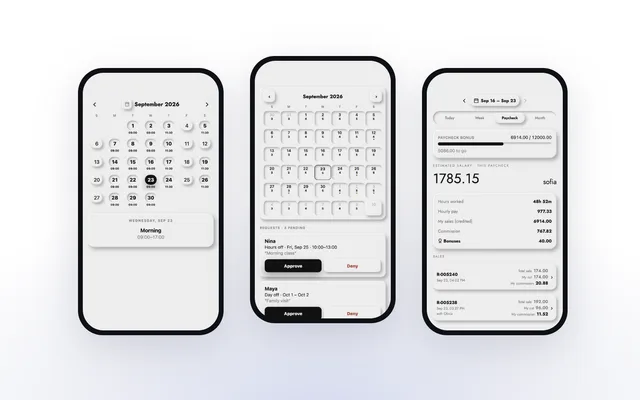
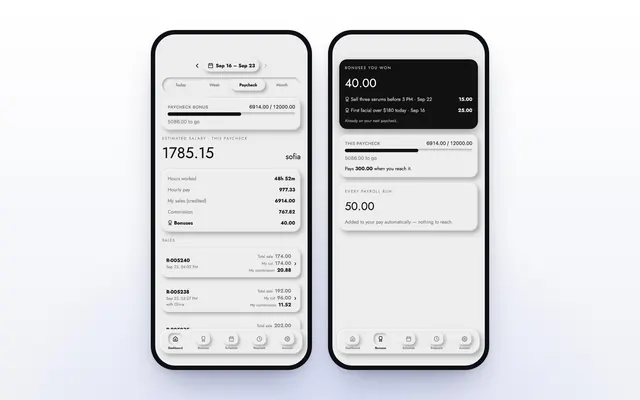
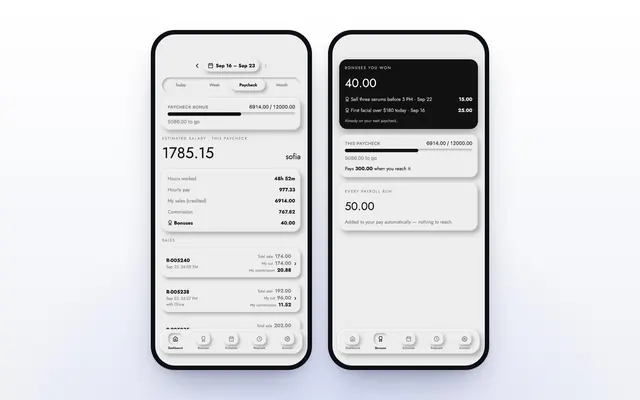
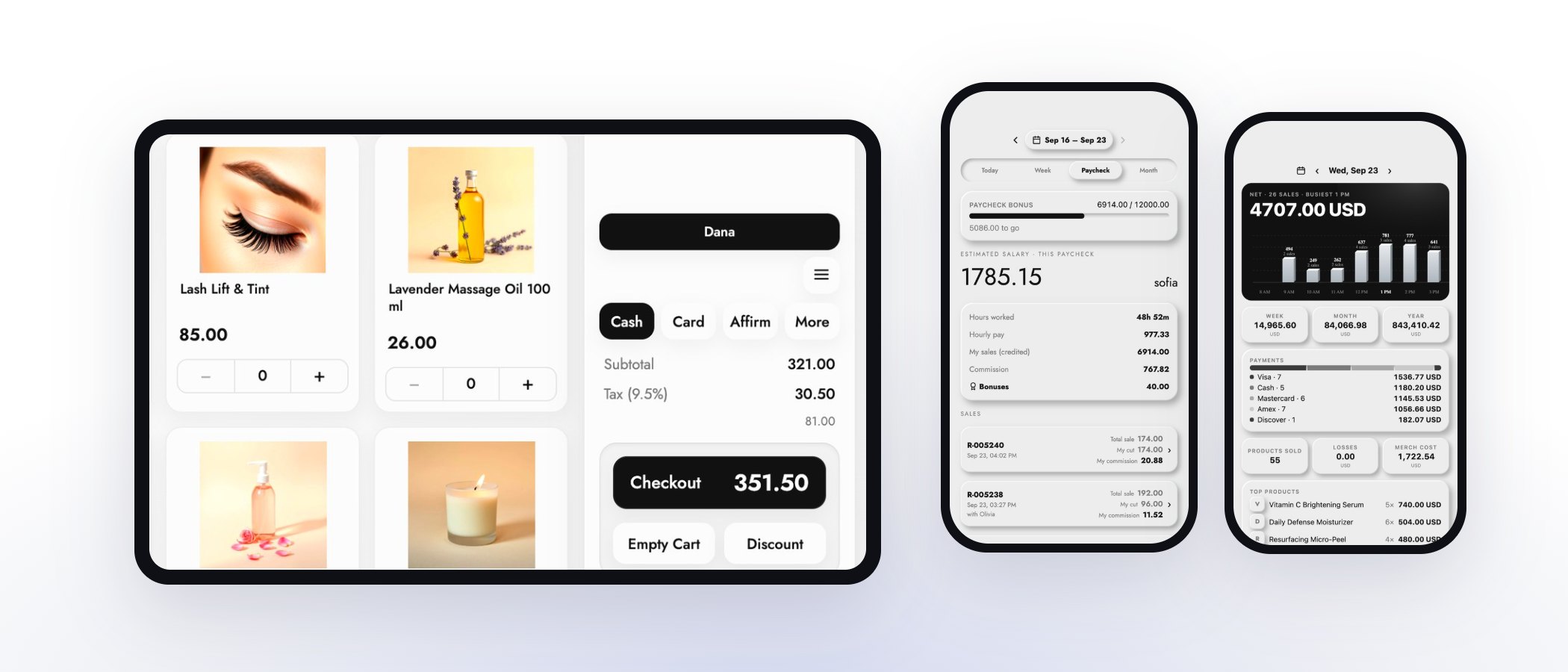
Yes, because a commission plan only motivates people who can see where they stand. In MazalPOS, every employee sees their own sales, commission and hours in the MazalTeam app on their phone, and nobody else's. When someone is $150 away from the next tier at 4 p.m., they know it. Read more about who sees what.
Can I change the commission plan mid-period?
Yes, but decide whether the new rates count for the whole period or only from today, and tell your staff before you save. MazalPOS asks you that exact question when you edit the tiers: the new tiers can count for the whole paycheck, or only from the moment you save, with earlier days kept at the rates they were earned under.
How does commission work in MazalPOS?
In the back office, each pay plan is a salary group: an hourly rate, optional commission tiers on each day's sales, an optional sales goal bonus, and an optional automatic bonus added to every full two-week paycheck. Put each employee in a group, and every sale on the register is credited to the person who signed in. Payroll adds itself up for each pay period, the 1st to the 15th and the 16th to the end of the month, with hours, sales and commission side by side. See staff and payroll, or try the free commission calculator first.
What does commission tracking cost?
MazalPOS is priced per location, with no charge for each employee. Essentials is $99 a month: the register, inventory, customers, reports, full staff scheduling, the MazalTeam app, and card and cash payments. Growth is $169 a month: everything in Essentials plus payroll and commissions, the online store connected to the register, and more than one location under one login. Every plan starts with 14 days free, no card, month to month. See pricing.
What should a commission plan checklist cover?
- One plan per role, written down in one sentence.
- Tiers say whether they pay the whole day or only the part above.
- Goal resets are daily, weekly, every two weeks or monthly, and staff know which.
- Split sales always add up to 100%.
- Commission and promised bonuses are counted in the regular rate for overtime.
- Every employee can see their own sales and commission.
- Rate changes are announced before they are saved.
Common questions
There is no single rate. Many stores pay an hourly rate plus a small percentage of sales, and raise the percentage with tiers or a goal bonus on big days. Pick a rate your margin can carry on every sale.
Tiered commission raises the percentage once sales pass a line. A goal bonus pays a fixed dollar amount when a sales goal is reached. In MazalPOS, a reached tier applies to the whole day.
Yes. Under federal rules, commissions are part of the regular rate of pay, so they raise the overtime rate for covered, non-exempt employees who work more than 40 hours in a workweek.
Yes, on the Growth plan. Commission is worked out on every sale from the tiers and goals you set, and each employee sees their own sales and commission in the MazalTeam app.
Sources

Written by Mike Akop, founder of MazalPOS. We build and support the register, online store and staff app that stores from Las Vegas to Honolulu run on. Questions about this guide? Talk to a real person.